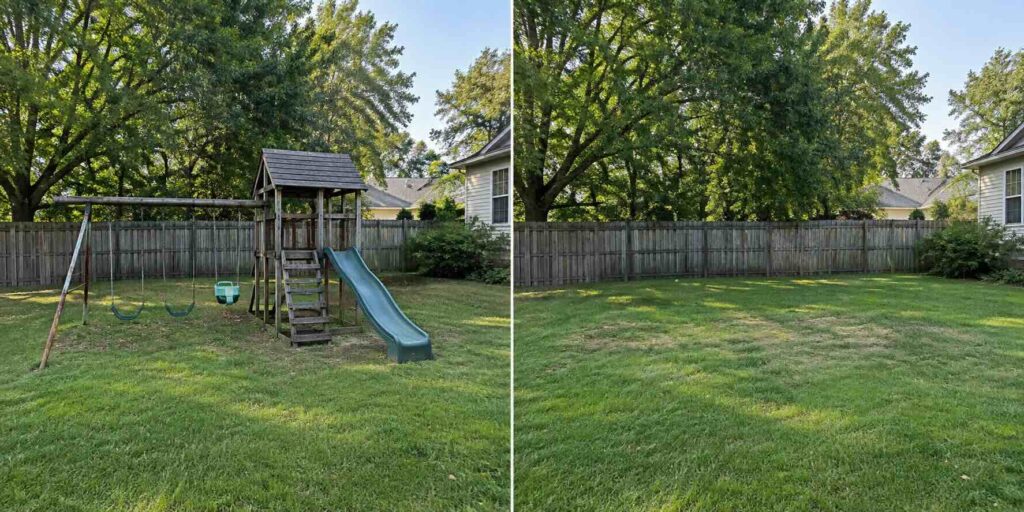
Play set removal often starts with a simple realization: the swing set nobody uses anymore is taking up a lot of yard, and getting it out will take more than a few turns of a wrench. Maybe the children have outgrown it. Maybe the wood has softened, the hardware has rusted, or the structure came with a house you recently bought. Whatever brought you to this point, you need to know what will happen to the play set, the debris, and the space it leaves behind.
We provide play set removal as part of our light demolition and junk removal services. That means we can inspect the structure, take it apart, haul away the material, and clean up the debris from the work. We serve customers in Harford County, Baltimore County, and parts of Cecil County. If you are elsewhere in Central Maryland, confirm your address with us before planning the job.
This guide walks through the decisions that matter before removal, what we look for when we arrive, how dismantling and hauling work, and what to ask about costs, disposal, and the condition of your yard afterward.
When a Play Set Needs to Go
A backyard play set rarely becomes unwanted overnight. A swing may disappear first. Then the slide cracks, a platform board loosens, or weeds begin growing beneath a structure that once saw daily use. By the time you decide to remove it, you may be looking at an awkward mix of lumber, brackets, plastic components, chains, and posts that cannot simply go out with the household trash.
Age alone does not tell you whether a play set can stay. What matters is its condition and whether anyone still plans to use it. Before allowing children onto an older structure, look closely at its supports, elevated platforms, railings, fasteners, swing attachments, and the ground around its posts. A structure that shifts, has visibly damaged load-bearing parts, or no longer feels stable should not become a weekend climbing project while you decide what to do with it.
Sometimes removal has nothing to do with visible damage. You may want room for a garden, a different outdoor activity, or a yard that is easier to maintain. A new homeowner may have no use for the previous owner’s equipment. In those cases, the main challenge is practical: how do you get a large, assembled object out of a fenced or landscaped yard without leaving a pile of material behind?
That is where the distinction between pickup and dismantling matters. If you have already taken a play set apart and placed the pieces where a crew can reach them, you primarily need hauling. If it is still standing, you need a team prepared to inspect and carefully deconstruct it before loading anything. Our light demolition service covers play set removal, while our junk removal service handles the heavy lifting and haul-away.
What Play Set Removal Includes
A complete removal job has several stages. The details depend on the structure and the property, but the goal is straightforward: take down the play set in a controlled way, move its components out of the yard, and remove the resulting debris.
Inspecting the Structure and Access
Before taking anything apart, we need to understand what is standing and how it is put together. A small metal swing frame presents a different job from a multi-level wooden play set with a roof, slide, climbing wall, and several swing positions. We also look at its condition. Rot, corrosion, loose joints, or leaning supports affect the order in which components can safely come down.
Access is just as important as size. We need to know how the material will travel from the play set to the truck. Gates, narrow side yards, slopes, steps, retaining walls, garden beds, and nearby structures can change how pieces must be dismantled and carried. Telling us about these features when you arrange an estimate helps us assess the whole job, not just the play set in a photograph.
Our light demolition process begins with an inspection and prioritizes a safe, deliberate takedown. We then remove the material rather than leaving you to find a second company for the debris.
Dismantling Rather Than Pulling It Over
The safest approach to an unwanted play set is not to assume it will fall neatly in an open patch of grass. Even when a structure looks fragile, its braces and fasteners may still hold some sections firmly together while other sections move unpredictably. A raised clubhouse, for example, needs a different sequence from a low swing frame.
We take the structure apart with attention to its connections and the space around it. Components such as swings, chains, slides, roof pieces, platforms, rails, beams, and supports may need to come off in stages. The exact sequence depends on what our inspection reveals. This is light demolition: carefully deconstructing a smaller structure, not treating the yard like a building demolition site.
A play set close to a fence, deck, shed, or house calls for particular care. So does one whose posts are surrounded by mature plantings. Let us know what you want protected and whether any part of the structure has recently shifted or broken. Those details can affect how we plan the work.
Hauling and Cleanup
Once the play set is down, it still has to leave the property. Long beams, irregular plastic pieces, metal hardware, and small fragments all need to be gathered and moved out of the yard. Our service includes hauling the dismantled material and cleaning up debris from the removal.
“Cleaned up” and “restored” are different things. Removing the structure does not automatically mean filling post holes, removing a large ground-cover area, grading soil, installing sod, or repairing every place the equipment touched the lawn. If those outcomes matter to you, discuss them during the estimate. That way, everyone understands what the removal quote includes and what would require separate work.
How Our Removal Process Works
The first useful step is a conversation about the play set you have, not the play set you wish it were. Tell us whether it is wood or metal, roughly how large it is, whether it has elevated sections, and whether you have noticed rot, leaning posts, or damaged hardware. Mention attachments such as slides, monkey bars, climbing features, and swings. If the structure sits behind a narrow gate or far from a place to park, include that too.
We offer free, no-obligation onsite estimates. You can schedule online or call us. On the appointment day, our team assesses the items and provides a quote for removal. Our junk removal pricing generally depends on how much room the material occupies in the truck; a standing play set also requires dismantling, so the estimate should reflect the work involved in taking it down as well as hauling it away. Ask us to clarify the scope of your specific quote before work begins.
After the estimate, the crew can plan the takedown around the play set’s actual construction and your property’s access. This is the point to identify anything you want to keep. Perhaps you plan to reuse a slide elsewhere, save a commemorative nameplate, or set aside a swing. Tell us before dismantling starts, and point out the exact component. Do not assume an item will remain intact or be preserved unless you have discussed it with us.
During removal, keep children and pets away from the work area and the route to the truck. You do not need to pre-dismantle the structure for a light demolition job. Clearing toys, movable furniture, or other loose items from the immediate area can make the site easier to assess, but tell us if you cannot do that safely. A deteriorated platform or unstable frame is not something you should climb onto to prepare for our arrival.
Once the structure is dismantled, we load the debris and address cleanup associated with the job. If you also have other bulky items or yard debris to remove, raise that during the estimate rather than assuming they are part of the play set quote. We handle a range of junk removal work, including yard debris and construction debris, but the crew needs to know what you want included.
Our site notes that same-day and next-day appointment windows may be available. An available estimate or appointment window does not, by itself, guarantee that every play set can be fully removed that day; timing depends on scheduling and the complexity of the project. If you have a deadline, such as an upcoming move or landscaping work, tell us when you contact us.
Details That Can Change the Job
Two play sets can look similar from the street and require very different removal plans. The most important differences are usually construction, condition, attachments, access, and what is below ground.
Wood, Metal, and Mixed Materials
Wooden play sets often contain a large volume of lumber, along with bolts, brackets, chains, plastic accessories, and sometimes fabric or roofing material. Metal frames can be simpler in shape, but their connections may be rusted or difficult to separate. Many backyard structures combine several materials. A slide that comes off easily does not tell you how readily the supporting frame will come apart.
Condition matters as much as material. A solid-looking beam may be weak near a ground contact point, while an old fastener may no longer behave as expected when loosened. We inspect the standing structure before choosing how to dismantle it. That is one reason photographs are useful for an initial conversation but do not replace an onsite assessment.
Posts, Anchors, and the Ground Beneath
What you see above ground may not show how the play set is secured. Some structures have ground anchors; others have posts or footings that call for a closer look. If you know how yours was installed, tell us. If you do not, say so. We can assess the visible setup onsite and discuss what the quoted removal will cover.
Be especially specific if your plans require more than a clear space where the structure stood. Preparing for new landscaping, a patio, or another installation may involve questions about buried materials, holes, mulch, edging, and the grade of the ground. Do not assume all below-ground work is included simply because a quote says “play set removal.” Ask which anchors or footings will be removed, what happens to any holes, and what condition you should expect when we leave.
The same applies to the material beneath the equipment. A play area may have mulch, rubber surfacing, landscape fabric, borders, or other ground cover. Decide whether you want that area left in place or assessed for removal, and bring it up before the price is finalized.
Tight Yards and Nearby Obstacles
A backyard can have plenty of open space around the play set yet offer only a narrow path out. A gate may limit the size of the pieces we can carry. Landscaping may make the shortest route the wrong one. Slopes, stairs, and distance from a parking area also affect the work.
When you request an estimate, describe the route from the play set to the street or driveway. Mention locked gates, pets, overhead obstacles, or areas you do not want used for access. If the property has an unusual layout, meeting the crew onsite gives you a chance to walk that route together and settle practical questions before dismantling begins.
Structures Attached to Other Projects
Some homeowners plan to remove a play set while clearing out an old shed or taking down a worn deck. We also list shed removal and deck demolition among our light demolition services, alongside play set removal and construction debris removal. A combined project should be assessed as a combined project: each structure has its own construction, access needs, and debris volume. Tell us about the full scope so the estimate accounts for the work you actually want done.
Removal, Disposal, and What Stays
Taking a play set apart produces materials that may have different destinations. Our stated approach is to consider donation for usable items, recycling where materials can be processed, and responsible disposal for what cannot be reused or recycled. That approach does not mean every component of every aging play set is suitable for donation or recyclable. Its condition and the materials themselves matter.
If reuse is important to you, say so early. A play set that is still safe and complete may raise different questions from one that is rotted or partly broken. Removing a structure for disposal is also different from carefully taking it apart for someone else to reassemble. If you hope to keep or transfer specific pieces, we need to discuss what is practical before work begins.
Do not leave disposal assumptions until the end of the appointment. Ask whether your quote covers all identified play set components and associated debris. Point out accessories that are not currently attached, such as a slide lying beside the structure or swing seats stored in a shed. If you want a separate pile of old lumber or other unrelated yard waste removed, identify it during the estimate as well.
Our junk removal service is designed to do the heavy lifting, and our light demolition service includes debris removal and cleanup after dismantling. That combination is useful when the real problem is not merely getting the structure down, but getting the resulting pieces off your property.
Understanding the Cost
There is no reliable one-price answer for every backyard play set. A small, accessible frame and a large, multi-level structure do not create the same amount of dismantling work or debris. Even identical models can differ after years outdoors: one may come apart in manageable sections, while another has deteriorated connections or awkward access.
For junk removal, we base pricing on the amount of space items take up in our truck, with several price points depending on the load. Our team provides an all-inclusive quote after assessing the items onsite. Because a standing play set involves light demolition as well as hauling, ask us what dismantling, debris removal, and cleanup are included in the quote for your property. We provide free, no-obligation onsite estimates, so you can review the scope before committing to the work.
The most useful questions about price are specific:
- Does the quote include taking down the entire standing structure?
- Does it include every attachment and loose play set component you identified?
- Are ground anchors, posts, or footings included, and to what extent?
- Is removal of mulch, borders, or other play-area material included?
- What cleanup will be completed after loading?
- Does the quote cover any additional junk or yard debris you have pointed out?
These questions help define the job while the crew can still see it. If your next contractor needs a particular area clear or your family needs a particular object saved, this is the time to say so.
Preparing for Removal Day
You do not need to turn a standing play set into a pile of boards before we arrive. In fact, if the structure is unstable, working on it yourself may create a risk you were trying to avoid. The most helpful preparation is to make the project easy to understand and the property practical to access.
Start by identifying everything you consider part of the removal. Check around and beneath the structure for detached swings, broken accessories, loose boards, or pieces that were stored elsewhere. Decide whether the surrounding ground cover is staying. If another household member has plans to keep a slide or a particular swing, settle that before the crew starts.
Next, look at the access route. Unlock any gate we will need to use and move easily movable items out of the path where possible. Tell us about buried irrigation, known utilities, or other property features near the structure that may not be obvious from looking at the yard. If you are unsure whether something affects the work, mention it during the onsite assessment rather than guessing.
Finally, give the crew room to work. Children and pets should stay clear of the structure, dismantled pieces, and loading route. You can still ask questions or confirm what will be removed; doing that before a component comes down is much easier than trying to sort it out from a loaded truck.
Afterward, walk the area and compare the result with the agreed scope. Look at the former play set footprint, the route used to carry material out, and any components you requested to keep. If a detail does not match what you discussed, raise it while the crew is there.
Other Light Demolition Services
Play sets are one part of our light demolition work. We also handle shed removal, deck demolition, construction debris removal, and hoarding assistance. In each case, the work depends on the structure or material involved rather than a single routine that fits every property. Our process combines assessment, careful removal, debris hauling, and cleanup.
A shed may need to be checked for utility connections before dismantling. A deck involves planks and underlying supports. A play set has its own mix of elevated sections, attachments, and ground connections. If you are clearing several areas at once, describe each one when arranging the estimate. That lets us assess the structures separately while discussing the overall project.
We also offer residential and commercial junk removal and dumpster rentals. Those services can meet different needs: a full-service crew handles lifting and hauling, while a dumpster may suit a project where you are filling it yourself. For a play set that is still standing, make sure you are discussing takedown—not just a container for material you would have to dismantle and load.
Play Set Removal FAQs
Do I need to take apart the play set before your crew arrives?
No. We offer play set removal through our light demolition service, which includes inspecting and dismantling the standing structure, hauling the pieces away, and cleaning up the resulting debris. If you have already dismantled it, tell us; the job may instead be assessed as hauling.
Will you remove posts, concrete footings, mulch, or playground borders?
Tell us about each of these during the onsite estimate. They may extend beyond taking down and hauling away the visible play set, and we need to assess what is present before defining the work. Ask us to state what the quote includes and what condition the ground will be in afterward.
How do you price play set removal?
We assess the structure and provide a quote onsite. Our junk removal pricing is based on how much truck space the material uses; a standing play set also requires dismantling, so confirm that the quote covers both the takedown and haul-away. The onsite estimate is free and carries no obligation.
What happens to the play set after you haul it away?
We assess materials for possible donation or recycling and dispose of what cannot be reused or recycled responsibly. The condition and composition of a particular play set affect what options are practical. Tell us before work begins if there are components you want to keep.
Can you remove a play set if the yard has a narrow gate or limited truck access?
Limited access does not automatically rule out removal, but it can change how we dismantle and carry the structure. Describe gates, steps, slopes, landscaping, and the distance to parking when you contact us. We can assess the route during the onsite estimate rather than assume large sections can pass through it.
Ready to Reclaim the Yard
An old play set can be both a large structure and a collection of small decisions: what comes down, what comes out of the ground, what stays, and how the debris leaves the property. Getting those details clear before work starts makes the removal easier to understand and the finished result easier to judge.
If your play set is in Harford County, Baltimore County, or an area of Cecil County we serve, contact us at (443) 206-1859 or schedule online for a free onsite estimate. Describe the structure, the yard access, and what you want removed. We can then assess the job in person and give you a quote based on the play set that is actually in your yard.